
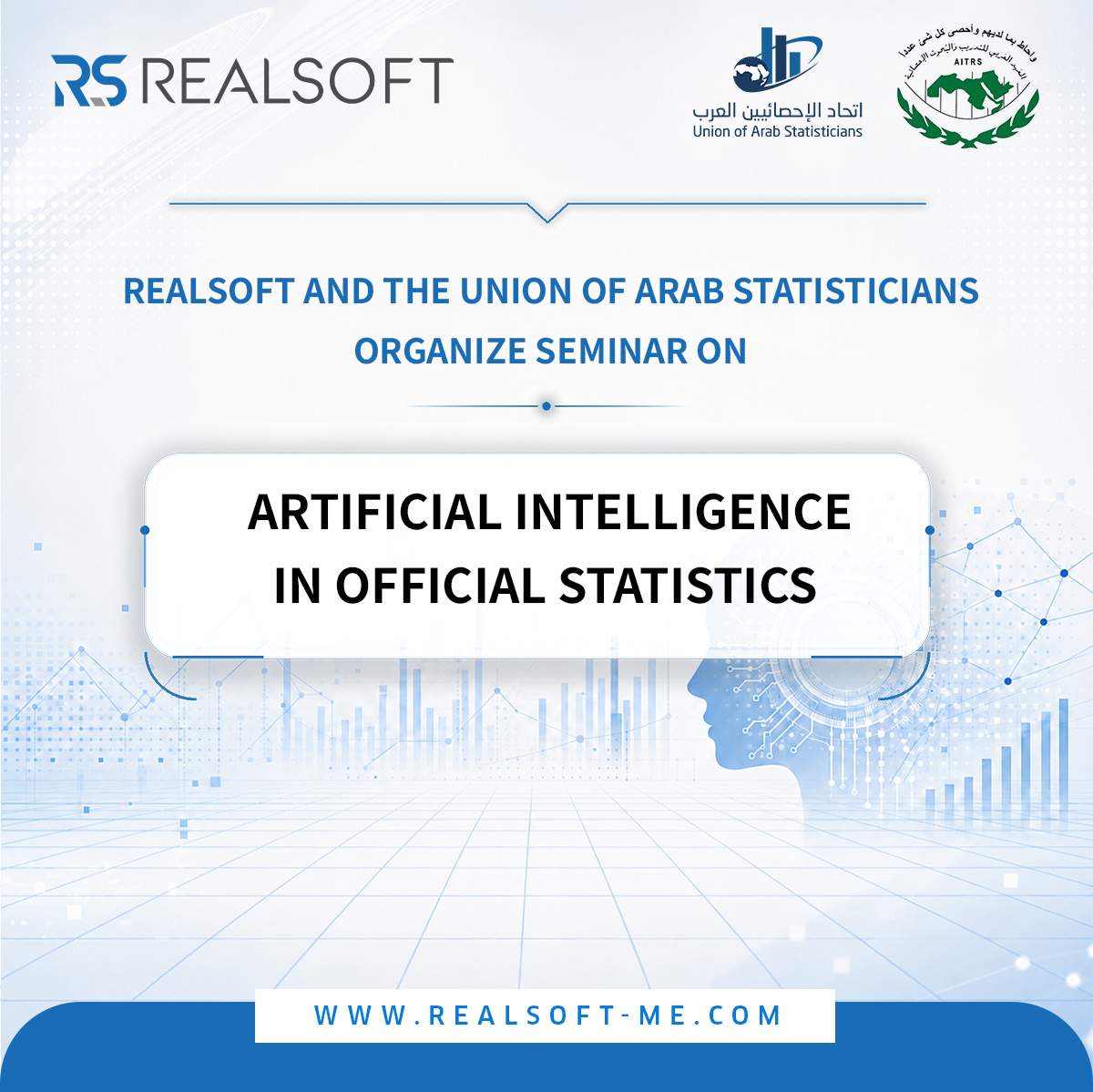
RealSoft and the Union of Arab Statisticians Organize Seminar on Artificial Intelligence in Official Statistics
August 2, 2026
RealSoft, in cooperation with the Union of Arab Statisticians, organized a specialized seminar on Saturday, August 1, 2026, titled “Artificial Intelligence in Official Statistics: Opportunities, Challenges, and Applications” held via Zoom. The seminar brought together specialists in official statistics, data, and artificial intelligence, along with experts from Arab statistical institutions.
The seminar addressed the requirements for integrating artificial intelligence into the production of official statistics and examined its potential across different stages of the statistical process, including questionnaire design, data collection, quality validation, analysis, reporting, and indicator forecasting. The session also discussed governance, privacy protection, and human capacity development, emphasizing the complementary role of statisticians and AI in reviewing, interpreting, and approving results.
The seminar was introduced by Professor Ghazi Raho, Secretary-General of the Union of Arab Statisticians, and moderated by Professor Mahdi Al-Alaq, Secretary of the Iraqi Statistical Sciences Association. Discussions focused on translating technological developments into practical applications within statistical institutions, based on each institution’s level of readiness and its regulatory and methodological frameworks.
Ali bin Mahboob Al Raisi, Advisor at the Sharjah Department of Statistics and Community Development, presented a perspective on the role of statistical institutions as the use of artificial intelligence expands. He explained that these technologies can support statisticians’ productivity and improve operational efficiency without fully replacing their role in design, analysis, and the approval of official results. AI can serve as an assistant to statisticians and accelerate tasks such as data collection, quality improvement, coding, analysis, reporting, and indicator forecasting.
Al Raisi also discussed the inclusion of AI within digital transformation programs and emphasized the need for connected administrative records and usable data, supported by governance frameworks that ensure privacy, transparency, and human review.
Dr. Ziad Abdullah, Director General of the Arab Institute for Training and Research in Statistics, presented a framework for building the capabilities required to apply AI within statistical institutions. He addressed the necessary skills, tools designed for statistical work, and methods for implementing them within national statistical offices, as well as research areas that could be developed through cooperation among statistical institutions, universities, and research centers.
Abdullah explained that statistical practices form the foundation on which AI models depend. He noted that the use of technical tools requires knowledge of survey and sample design, data quality assessment, error and outlier detection, time-series analysis, statistical modeling, and the interpretation of results within their actual context. He also called for AI and digital statistics to be incorporated into academic programs, alongside the establishment of joint research laboratories and applied research projects implemented in cooperation with statistical institutions.
Jaafar Mansour, Chief Executive Officer of RealSoft, discussed the development of generative AI models and their ability to process text, software, mathematical problems, and statistical contexts. He examined how these models could be used to automate a range of statistical applications and tasks under the Generic Statistical Business Process Model (GSBPM). Provide examples of data processing and quality improvement, from error detection and correction suggestions to consistency checks and the measurement of processing performance.
Mansour also presented several methods being studied for conducting censuses under exceptional conditions, including bottom-up population mapping, edge AI operating on end-user devices, and anomaly detection. These methods were discussed within scenarios related to the planning of the 2027 Palestine Census. He ensured that expanding the use of AI requires a clear legal and ethical framework, defined quality standards, and procedures that ensure transparency and allow results to be reviewed.
Yaman Al-Ashqar, an AI researcher at RealSoft, delivered a practical presentation on applications that can be incorporated into the statistical production cycle, from questionnaire design and data preparation to collection, validation, monitoring, analysis, indicator production, and decision support.
The presentation included examples of AI-assisted form creation, biased-question detection, staff training and assessment, intelligent help desks, support for field researchers and call-center staff, text and voice translation, duplicate and unusual-pattern detection, AI-supported dashboards, and the analysis of responses to open-ended questions.
Al-Ashqar explained that the accuracy of these applications depends on the completeness, consistency, and regular updating of data, as well as the removal of duplicates, the integration of data sources, and the implementation of defined governance controls. He also emphasized that these tools are intended to support specialists, while model review, output quality assessment, interpretation, and final decision-making remain the responsibility of statistical experts.
The seminar included effective participant interventions on the readiness of Arab statistical institutions, approaches for initiating AI projects, the development of national capabilities, data quality, privacy and confidentiality protection, and the limits of relying on generative AI in official statistics. Speakers emphasized that institutional implementation should proceed gradually, based on the needs of each statistical office and its technical and regulatory readiness.
The discussions concluded that the use of AI has become necessary for the continued development of official statistics, with a focus on data quality, clear governance frameworks, statistical and technical skills, and human review of outputs. The seminar also emphasized the need to combine statistical expertise with digital tools when developing official data production processes.
